
Taco Bell Executive Creates a Breakthrough Dementia Caregiving Plan for His Mom

 Apple Podcasts
 Spotify
 YouTube
 Amazon Music
 RSS Feed
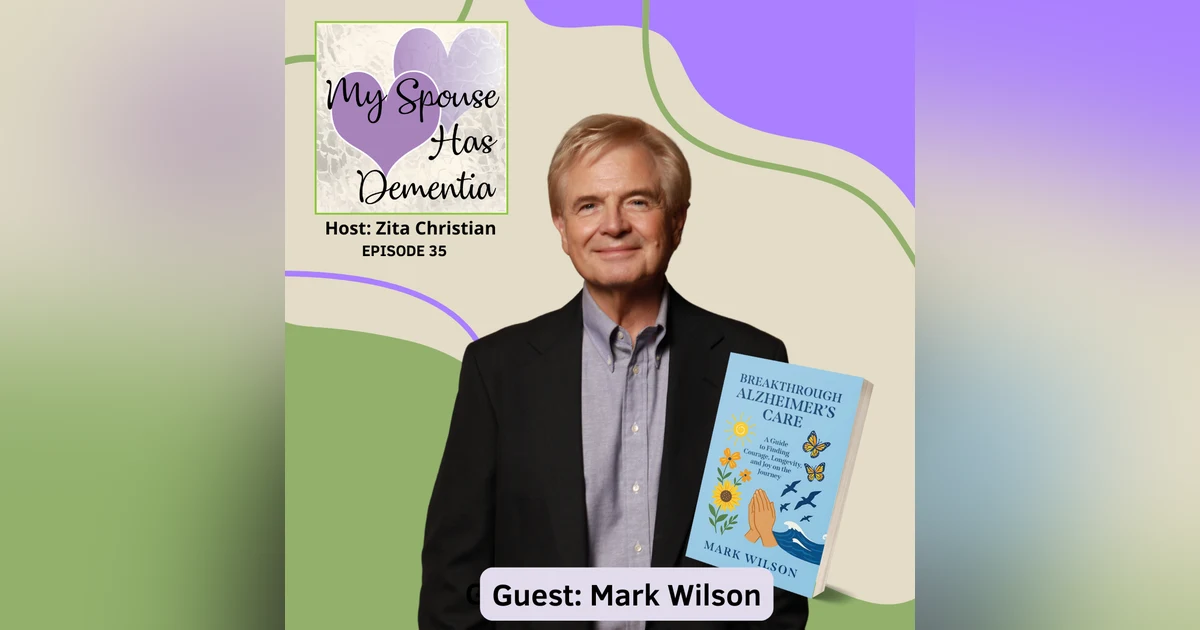
 Until his mother was diagnosed with Alzheimer's, Mark Wilson was a human resources executive at Taco Bell. Doctors gave his widowed mom six years to live. Mark retired, moved back home, back to the bedroom of his childhood. And he made a plan.
- He drew on his corporate experience to build a caregiving team of five aides who cared for his mother 24/7.
- He researched how particular foods might help his mother and he took over the cooking.
- He searched for a doctor to help his mother with a painful ailment unrelated to dementia. He found a guru!
These are just a few of the steps he took, all of which are explored in his book, a memoir self-help book titled Breakthrough Alzheimer's Care. With the help of his sister and the breakthrough ideas in Mark's plan, their mom lived 15 more years, not 6.
His website, BoldCareLeader.com, is full of helpful information and free resources.
Are you caring for a spouse with dementia? Have you written a book about dementia? Please let me know. I'd love to speak with you. Send an email to: zita@myspousehasdementia.com
TRANSCRIPT
Zita Christian 0:00
You find yourself in the role of caregiver for a family member with dementia. You need to hire professional help. How do you start the process? What questions do you ask? At the height of a successful career at Taco Bell, my guest moved back into his childhood home, back to the bedroom he had as a kid. His mom had been diagnosed with dementia. He became her caregiver. More accurately, he became the head of a team of caregivers. He took a unique approach to the task. That's because he had 22 years of experience as a corporate executive in human resources, and he has written a book about what he learned. The book is called Breakthrough Alzheimer's Care, and his name is Mark Wilson.
Zita Christian 0:49
You're listening to My Spouse Has Dementia, a podcast that uses personal stories, occasional interviews, and simple rituals to support dementia caregiving spouses. I'm Zita Christian, writer, life cycle celebrant, widow. My husband had Alzheimer's.
Zita Christian 1:10
Mark, welcome to the podcast.
Mark Wilson 1:13
Oh, thank you so much, Zita. I'm so honored to be here. Thanks for having me.
Zita Christian 1:16
I'm just delighted. I've talked with a lot of people who are involved, or they're in some place along that dementia caregiving journey, and what I have found for most of those conversations is the caregiver is reluctant to reach that point where they will ask for help. It's almost like a ...I don't know... a badge of honor or something that you know that idea of I can handle it myself and they don't need help. When the person really gets to that point where there is no alternative, if you want to keep the person you love at home, you have to get help. Then comes the question: How do you get the help? How do you start? Where do you start? And what do you ask? How do you know you're making good decisions? And so when you reached out and I explored a little about what you talk about. I thought this is gold because I'm not hearing anybody talk about this part of the dementia care journey. So, thank you for being here. Not just because I I think you have a lot of just generally interesting information and life experience to share, but you bring a specific piece that I have not seen anywhere else.
Mark Wilson 2:25
Well, thank you, Zita. Yeah.
Zita Christian 2:26
So, so let me jump right into that, and this ties so directly to your career in HR. And one of the things that I read about you was that you take best practices from what you had learned as an HR executive at Taco Bell, and you use those best practices in your role as a caregiver. So I want to talk about a couple of those in particular. First one, recruiting. How did you start to even look for caregivers? Because my assumption through all this was you decided not to go through an agency. Is that correct?
Mark Wilson 3:01
No, actually, I was blessed with the fact that my I I bought long term care insurance for my mom. My dad died really young, at 55, and so some one of his insurance agents said, "Yeah, I know your mom is financially dependent on you. Why don't you get long term care insurance just in case something happens to you?" So I did, and that and they required that I use agencies in their in the contract, so I did no. I definitely used agencies to help me.
Zita Christian 3:27
All right, that makes the that makes the conversation even more complex in from where I'm looking at because I did I did work with an agency for a while for about seven months, and I had care just for two mornings a week for my husband, but I was here at the house most I would say 99% of the time while the aide was here, and I made assumptions that the the agency had they had vetted everyone they had asked all the important questions. It wasn't until I got interested in what you did that. I thought, oh my gosh, I could have done so much more, and I'm very happy with the way thing turned. The way things turned out, Pamela was a... she was a godsend for sure. But I know that's not always the case. So even working through an agency, what did you do? What what kind of questions did you ask?
Mark Wilson 4:19
Oh, I'm happy to share that. So, first of all, as chart and leader of all talent of Taco Bell, I knew that the quote-unquote talent pool was very important. So, my idea was, why would I just use one agency's agency when I could use many agencies and get the best of the best from each agency? So, I actually worked with not one agency. I worked with five different agencies, and asked them to give me your best candidate in in this category. Somebody with dementia experience and, you know, kind. And so anyway, they would send me somebody they thought was good. I would interview them from each agency, and I would pick the ones that I liked the best, and then give them a trial shift. But the questions I would ask were questions that I kind of... the framework was really what I learned interviewing leaders at Taco Bell forever, and that's really you want open-ended questions. You want them to share their experience about how they handle various things, and so I would give them a difficult situation and say, okay, how did you handle this kind of a situation? So, for example, you might say, okay, did any of your patients resist taking a shower or bath? And that that's very common, you know, where dementia patients don't like to be in the water in the shower. And then, how did you handle that? And so, first of all, they said, oh, I've never had any difficult situations with dementia patients? That was that's a lie. So they're out. So and then if they if they sound like they like oh I just made them do it you know or they're just curt or you know critical about the situation they're out because I want somebody who's creative and figures out you know some some creative ways that they could get somebody to do something that's that they don't want to do, and we know that a lot. You know, those of us who kind of know about dementia now know there's you know that one of the tactics is kind of diversion. So get them to kind of focus on something else, and if they focused on like a game or a way to make the make the shower look fun, you know, then I thought that's the kind of person I want, and and so that would zero it down, and then I would evaluate those folks and give them a sample shift, and I'd watch two things. I'd watch on their sample shift, a were they safe with with my mom? So safety is always number one to me. Did they kind of hold her when they walk with her? My mom could walk, but I thought, okay, you know, are they careful about having like one hand on her, one hand on the walker while they're walking? How did she? They do on transferring her. So safety was big, and then the other part was the fun part. Did they have a connection with each other? And it wasn't always easy because my mom lost her speech really early, early days. But she, she, you know, she still had her personality, you know, and her mind in those, you know, early to mid phases, and so did they have fun together. Were there is a connection? Was there love, touching, caring? And you know, if a caregiver didn't do that well, they didn't get invited back. If they did, then I invite them back, and then would see how they went over time. But yeah, no, the interviewing process, you know, multiple agencies help interviewing more than one person. It was so funny because agencies are used to not doing that. Agencies would say, "Oh, we'll send somebody over. I said, "No, no, no. I'm interviewing them first, and I'd meet them at a local Starbucks. I didn't bring them home at first for interviews because I thought it might be confusing to my mom to have all these people come in, and you know, so we met at Starbucks. I would interview them, and you know, they leave. I take some notes about what I liked and any concerns they had, and and so that that's how I kind of did the recruiting process with these caregivers, and it really paid off because I I made some mistakes in the beginning.
Mark Wilson 7:57
I get I gave people a chance, like one one woman, I gave overnight shift was my first priority because I needed to get some sleep, and so this woman fell asleep, and was the only time I'm she didn't fall. My mom almost fell, but I could hear that kind of her banging, you know, against you know the furniture. She was okay, thankfully. A little got a little black eye, but other than that, she was okay. But anyway, the the woman was so funny. She says, "Oh, your mom went so fast down the bed. You know, I had these little half rails for down the bed, and she fell. I thought, "No, how fast could she be? So, so I had for beginning shifts. I had an overnight camera for people, especially overnight, and for new caregivers, once once I somebody proved themselves, I didn't turn the camera on, but I did have a camera on because it was her first overnight shift. I looked at this tape, and she was fast asleep, you know, on the ground. And I thought, oh no, no. So I said, okay, bye bye. You're going home, no more. So you know, so so I made some mistakes, but I finally landed on the five most amazing caregivers who worked basically full time for the last six years of my mom's life because she needed 24/7 supervision, and my role shifted from direct care, which I did like kind of for a year and a half before. To your point, I just was burned out. I couldn't do it anymore, and I couldn't really lead the the overarching things I wanted to do with my mom to experiment to make her live happier and longer, but I was able to be a care leader because these caregivers were great, and they never they worked for me for anywhere from four to six years. These five caregivers, and they they never even had an inkling of leaving, and they were paid whatever the agency paid them. I don't even know, but I'm sure it was average or competitive. But I treated them like gold. You know, I treated them like family. I recognized their great work. We would celebrate things in their lives and vice versa. So it was, and we're still. My sister and I are still friends with all five of the caregivers, even though my mom. Been been gone a few years now,
Zita Christian 10:03
Mark, that's so admirable on so many levels, because I think that caregivers-they're so-I'm speaking in generalizations now-but so underappreciated until somebody is in a position where you have to provide the care yourself, and it's not only the the physical challenges, but there's that there's the mental stress of being, in some cases, hyper vigilant to make sure that you know that something doesn't happen. I want to ask though, the questions that you asked initially, how would those questions have changed? Like fast forward a couple of years after you've had some experience, and now maybe you have to interview for another one or two caregivers because maybe people have moved or retired or whatever. Would those questions be different?
Mark Wilson 10:51
Good question. I'd probably I'd probably emphasize the fun part even more and the caring part because I learned that that's the most important part of the relationship between a caregiver and your loved one. So, for example, I learned that if the caregiver in the interview didn't ask good questions about my mom, I didn't like them, and and that was became more important because a caregiver that's really inquisitive about what is your like, what does your mom like to do, what's fun for her, you know, questions like that say that's top of mind for them. If they don't ask any questions, or they ask questions like, you know, is your mom incontinent, or you know, some things that you know we tell them where their mind is, or mind is on you know, do the easiest job possible, not on connecting. So those things I kind of learned over time that are really really important. Where their heart is, and these five women that worked with me over time were just amazing. They they were so loving and caring and flexible, and yet they had the foundations of safety, which was really critical for me. But on top of that, they were just the most amazing human beings on the planet, really, and and I was so blessed to find them. I was so blessed that they kept working for us, and that we're still friends. It's amazing.
Zita Christian 12:09
I wonder, you know, because your experience was so positive, that maybe that's. I wonder if that influenced how your choice to stay involved, as you know, as leading a support group and doing some of the work you do in in Washington, and I want to get to that a little bit later, but I want to stay with this subject just for a couple couple more minutes. One of the things that I thought about because I run a very small dementia support group. There there were a number of us to begin with. Now there are just four of us left. People have you know their needs aren't there anymore, and they're not in the group, and they've they've moved to very different parts of the country. One of the things that has come up with two of the people consistently is that it's frustrating to, even though they love having the care, they love having a caregiver there, and in one case it is 24/7, but the frustration of always having somebody in the house, never feeling that in this one case she never feels she has her her home to herself anymore. So I wonder for your mom, there were all there was always somebody there, and there were five different women. So how did your mom react to that?
Mark Wilson 13:18
Well, I think I think you raise a good question because yeah, as you mentioned, I lead support groups, and it is a concern. But my mom is the opposite. I think it's partly because these women were so fantastic. I mean, they made everything fun. She loved seeing them. I mean, they were like part of the family, and so there was no anxiety about strangers in the home because they, you know, maybe in the beginning, but they were part of the family, they weren't strangers. That was the point. And for my sister and I, oh, was it was fantastic because you know we looked at the opposite. They were helpful to us. I mean, it was it's emotionally moving. And my sister is a little bit. I mean, I'm I was super connected with my mom. I'm emotional person, but maybe it's because I'm a guy. I'm not sure. But my sister was more emotionally wrought over my mom's dementia, and so these these caregivers supported her. I mean, they would be friends with my with Marina as her name, and help her and give her advice and be supportive. So they were a blessing to us as well as to my mom. So,
Zita Christian 14:22
What about cooking and cleaning? Did these aides do some of that work, or did you have to hire someone else for that?
Mark Wilson 14:28
Oh, that's actually a great question because my goal was to have these folks be superstars in connecting with my mom and keeping her safe at every moment. So that role of cooking, cleaning, taking care of things-I looked at that as my sister in my role because I wanted to be support to them, not have them do these other things. I wanted them to be totally focused on my mom. So my sister, because she was a little bit more emotionally, you know, wrought, she couldn't do. The connecting with my mom directly, so she was great because she was my superstar, you know, sixth man of the year, sixth woman of the year. Because she would do, you know, a lot of the cleaning. I mean, laundry is, you know, dementia patients sometimes, you know, don't get to the bathroom fast. So she would do laundry a lot. She would help with the yard work. I would kind of do most of the cooking because I was kind of really tuned into my mom's diet and changing to all healthy stuff because I read that the diet makes a big difference for dementia patients. So, and my sister would help me if I was like, "How do you do this, Marina? Because she's she knew how to cook. She was a good cook. So, so but I was kind of doing the cooking, and then she was doing all the other support. But no, that's actually an interesting point because when when I go to these support groups, you know, people are okay. You know, I really helped somebody. They they came in, they did cleaning and cooking. It's like no, I want my caregivers to focus on my mom and and be totally 100% dedicated to that, so they're not spread too thin, or my mom isn't watched all the time, or there's a risk of her falling. So that was kind of my strategy. It's a little different than most.
Zita Christian 16:08
Did your mom have any pets?
Mark Wilson 16:10
We had a cat, and yeah. So that's an interesting thing. I I talk about that in my book about pets for breakthrough pillar number three. That sometimes a pet can be a safety risk if they get in the way or a fall, but my mom's cat was not. I mean, a cats tend to not be as you know risky as far as stepping over them or knocking you over or something. But yeah, no, my mom loved the cat. The cat would jump in her bed and kind of hang out with her. So yeah, yeah.
Zita Christian 16:41
You know, you you've answered some of this question already, but I'm going to ask in case there something else you wanted to add, and that was defining and setting your your own expectations for what you wanted, because my guess is somewhere along the line, only because people are different, and you're talking about having five different caregivers, were you able to maintain the same expectations with everyone, or did you have to adjust, like maybe depending on whether or not they were covering a night shift?
Mark Wilson 17:15
Yeah, no, that's a good question. So, the safety things I was very clear about. Very important that all of them safety expectations are high. Make sure you're always holding my mom when you're walking with her. So I mean, some caregivers if they kind of just let the walker go and they they step away. No, no, no. I wanted them to have a hand on mom, a hand on the walker, kind of make sure she she she was because you know dementia patients kind of get distracted or you know, and that you could. Sometimes my mom would like take her hands off the walker, and then I said, "Oh God, she's going to fall. So I said, "No, you got to be close when you're walking with her. Transferring is really important. You got to be a direct holder of my mom when you when she got from you know sitting to standing or vice versa. And so those safety things were were really important, and I would emphasize them continually. And then the other part was a little bit more artistic, where each individual caregiver was a little different on the fun and the love and the caring, but what they did was different but common thread. So the love and the caring were common. The fun was common. How they executed that was a little different. Everybody, like you know, one of my caregivers were was terrific at you know singing with my mom and playing music and that kind of stuff. Another one was really good at games and drawing with her, and you know, they all had kind of their special interests. But collectively, they really emphasized the fun part, the love, the caring, the touch-they all were very touching. I mean, that's the other thing. They would-they'd all walk in, and I never coached them on this, but they would come in and they would give my mom a big hug and a kiss on the cheek, and and she would do the same thing to them, and and so it was like just natural that they were just a caring person, you know, and that was important.
Zita Christian 18:58
So in six years, I'm guessing that there was at least once, maybe twice, where your expectations were not met. And then, what do you do?
Mark Wilson 19:11
Well, that's a great question because one of our caregivers was just was terrific overall, but she had a lapse where my mom had a safety risk, and I talk about this in my book. And so she, we you get we we go on daily outings. We take I talk about an adventure. We go on an adventure every single day and take her out because that was good for her mind. It was good for her walking, but she was getting into the car, and my sister went with them. I wasn't there at the time, but my sister went with them on their excursion, and my sister noticed that the caregiver was not kind of holding on to her and helping her get into the car, and then my mom like walked away, just stepped away from her walker and almost fell, and my sister grabbed her thankfully so she didn't fall. But my sister told me about this, and so I had a coaching moment with this woman, and I this is also in the book. I I learned how to coach leaders. There's a coaching framework in the book about how do you ask questions that get good caregivers to be great. That's the idea. So they this woman knew what to do, but she just had a lapse and didn't do it, so I asked her a series of questions. I said, "Okay, well, my sister told me about my mom almost fell, and you know, kind of set up the situation. And then I would ask questions like, "Why? Why was that? And then she identified. She says, "Oh, I wasn't holding on to her at the time, and I tried to straighten out the seat. And and I and I was like, "Well, don't you know? And she said, Yeah, it was a mistake because priority is safety. Yes, yes, you're right. So I would ask her questions that get got heard the aha about what she did wrong, and so that she didn't do that anymore. And so, and I would ask questions like, what can we do to help? And I said, well, you know, you could have asked my sister to hold on to her, or or you know, or let her straighten out the car and get ready for her coming into the car, and and you you know, so she said, yeah, that's right. You guys, you know, I'm glad you kind of one of one of you usually goes with me when we go outings. So anyway, so she through the question, the coaching process, she learned herself what she did wrong, and came up with a solution. I said, "What's the solution? You know, and she kind of outlined what the fix would been, and so that helps. That helps because we didn't want to. I had no interest in getting rid of her because she was awesome, but I wanted her to not do that again. So I, her questions. If you can, you know, what I learned from my work experience is, if you can identify the problem and the fix. It's a lot better than telling them what to do. So...
Zita Christian 21:43
Oh, I really like that so very much because then the the caregiver feels, I'm guessing here, feels a part of the solution as opposed to being reprimanded.
Mark Wilson 21:56
Exactly.
Zita Christian 21:57
I mean you have to acknowledge the problem. Obviously, you can't just like pretend something didn't happen, but from the caregiver caregiver perspective, there's also that feeling of I'm not being let go. Of course,
Mark Wilson 22:09
yeah,
Zita Christian 22:10
I have a chance to to be even better than I was.
Mark Wilson 22:13
Yeah, and it maintains their self esteem. They come up with a solution. They feel good that they had the right answer and how to fix it. And so, yeah, it's it's a win win all the way around that way.
Zita Christian 22:24
Question about age: the age of most of these caregivers was it was it like within you know 20 years or so of your mom's age, or or was it vastly different?
Mark Wilson 22:34
It really varied quite a bit. I found that I had one caregiver. My mom was in at that time was in her kind of late 70s. She again she had she had this because I extended her life by a lot. She had this Alzheimer's for 15 years, so she went from 72 to 88. You know, so but the oldest caregiver we had was maybe 66 - 67, but she was so spry. She was she was from Peru. She had I I called her. She's like llama energy because she she was just so energetic. She she acted like she was you know 40, not you know not in her late 60s, and then the youngest was probably oh maybe 30. So that's kind of the range. Yeah,
Zita Christian 23:19
I'm I'm asking because I wonder, you know, with dementia, and I don't know about all the the various different causes of dementia. I can only know firsthand experience because of my husband who had Alzheimer's. As the disease progressed, his mind changed to seeing himself younger and younger and younger, and I wonder if that was the same for your mom, and did she relate differently to someone who was younger? Did she see herself at at that younger age?
Mark Wilson 23:48
It's a great question. I didn't really notice anything that said that she did or didn't, but she got along with you know all five of these caregivers because they were special, connected, you know, loving, compassionate people, and so yeah, I don't. I didn't notice any difference in how she treated them based on their age. So I don't know.
Zita Christian 24:07
What about your mom? Your mom herself. Did you learn anything about her as a woman because of watching her interaction with these caregivers?
Mark Wilson 24:17
Well, that's a good question. I did learn that some of the kind of, I mean, for example, music. She loved listening to the old. She, you know, she was you know young in the 50s, and so when when the caregivers figured out that that she loved that, they would play Frank Sinatra and Dean Martin and the big bands, and you could just see her. Even though she lost her speech, she couldn't sing, but you could see her dance, and she would like kind of rock and roll. Yes, she would hold onto the walker and like shake her hips, and she was just that and smile. So you know, music. I didn't realize she was would would be such a powerful thing for her. And then she would love to do these adult coloring books too. She would, and I didn't know this about her, but she we would buy these adult coloring books. And they were pretty complicated, but she was able to to choose the colors. She would be able to draw in these fine lines, and focus, you know, really on it. And you could just see her smiling as she was doing this this coloring. And she was proud of her work. And then we put it up all over the house to show that we were proud of her. And you know, like you might do that, you know with a child, and so she loved that stuff. And it's so funny because once in a while I'd sit down with her and I'd pick up a pencil and try to draw in her drawing. And I'm I'm not I'm not very artistic at all, but she would like you know even though she couldn't speak, you know she would look at me, she'd smile at me, and then she'd push my hand away. Like I could just hear her going, "Hey, I love you, son, but you're messing up my drawing.
Zita Christian 25:44
I'm going to switch gears here for a minute. One of the challenges that I have seen in members of my own support group, or not so much my own support group, but ones that I've been in online, you know, not the in-person kind, and that is a question about, or the challenge that comes about communicating with the neurologist, with the family doctor, with a nurse practitioner, even with a pharmacist, and you have, I know, some experience. I'm guessing from your corporate work, from your executive background, that has to do with communicating. And I want to talk about a couple in particular on the part of the caregiver, an automatic assumption of authority, giving authority to whoever the the medical professional is, and also for so many of us who are new to the caregiving experience, there's an unknown vocabulary. And then what I see in every every class I've ever taken, somebody says, "I know this is a stupid question, but so there's that idea that I don't want to ask this because I'm going to look stupid, but I don't know that vocabulary. I don't know what that is, and then that that big thing of I'm placing trust in you. I'm seeing you as the authority, but do you really know? And are you looking at my you this medical person, are you looking at my loved one as patient at you know 130 p.m. or is this a real person? Talk about that whole idea of communicating with those professionals.
Mark Wilson 27:13
First of all, this whole area is very important because medical care with dementia patients or anybody elderly, for that matter, is critical, and so I'm used to dealing. I was used to dealing with senior executives, big, powerful, big ego people. So doctors, generalization, not not all doctors, but many doctors have this big ego, and they're you know racing to see as many patients as you can. So my idea was no, no, these are just people, just like you or me, and the the authority thing is interesting because I realize that doctors come in all forms, just like any worker. There's poor workers, there's average workers, good workers, and gurus that are just extraordinary. And doctors are the same way. Just because you have a medical license doesn't mean they're all great. You got some poor doctors, you got average doctors, you got good doctors, and then you got super gurus. And so, my idea was I didn't want anybody that was at least a good doctor taking care of my mom. So, so you know that was important number one. And I I treated them like anybody else. I I didn't have, you know. I didn't think of them as these authority people. And as far as the knowledge, I was used to dealing with people on my team that knew more about their specialty than I did. But I had to know enough about what they did to lead them. So I would I would read a lot about whatever was going on with my mom. Mom had dementia. She also had some cardiac issues. She had some kind of other weird stuff. Vulvar pain. There was there was another whole story about nobody could diagnose that. But anyway, so I I would read enough about these things from you know leading. There's you can do it online. There's lots of online sites I talk about in my book about where to get this information, and just read about them. You don't have to be. You're not going to be an expert like the doctor, but you're going to know enough to ask good questions. You need to know enough to be able to make decisions for your loved one, because Alzheimer's patients, you know, can't make their own decisions medically. So you have to have some base knowledge of whatever's going on with your loved one's medical world, and that gives you a little more confidence to be able to ask good questions and to you know know what the whether you're going to go with whatever the doctor says because that's the other thing. You don't always have to listen to the doctor. I mean, if they if they're coming up with you know strange ideas, get another opinion. Or or if your intuition says I don't know that seems like a little overreaction or underreaction, then you know get another view. If you live in an urban or suburban area in the country, there's many many choices for doctors. You don't have to put up with anybody who's not great. So, so that was kind of my overall philosophy. And then, I ended up, you know, figuring out what questions to ask these doctors. In fact, in my book, I have a good list of doctor questions. For patients with dementia, that are that connect their experience with a dementia patient and kind of evaluate their experience, knowing the unique factors of dementia patients. So, so one is you know, dementia patients not always, but early onset is younger. But all you know, people have dementia older, you know, in their 70s or 80s or 90s, they're kind of have some common things that you don't want to do if you're younger. So if the doctor doesn't have experience with older people and older people dementia, that's not a good thing because the body is different. I mean, you don't want older dementia patients to go on anesthesia, for example, unless it's absolutely mandatory, because that does set you back your brain health. Other other medications, same thing. I mean, you don't want to give your loved one Xanax or some of these other you know kinds of medicines that knock them out, because that takes away from their brain power.
Mark Wilson 30:55
And so, so you have to kind of get a sense whether that doctor kind of knows that stuff, and if they don't, they're not tuned in enough to elderly dementia patients, which are have unique profile of what they can take and not take and do and not do. So you have to kind of evaluate their experience level with these with your kind of loved one's condition. And so the other thing too is very difficult for dementia patients to go to a lot of doctor appointments because it's hard to get them to move. Some of them are agitated. I know that, but you still want the care. So, one is: is the doctor available by phone? Some doctors now you just cannot talk to them by phone, and so that was an important factor for me. If the doctors like would not talk to me on the phone if I had a routine kind of question, so I didn't have to bring my mom in. Then I would find a new doctor. If the doctor was like, you couldn't get an appointment for weeks and weeks, find a new doctor because you don't. I mean, dementia patients need care, you know, relatively immediately. If you can't get an appointment in a few days or a week at max, find a new doctor. So those are kind of things that were in my mind about you know medical care in general. And if your your loved one has has a situation where it's hard to diagnose, or they're not fixing the problem quickly, find a guru. In the book, I talk about two things that my mom had, where the the kind of average to good doctor just couldn't figure it out, and so and I went to too many of them before I realized I needed a guru. And then in the book I talk about how do you find a guru, and those are people that are that teach on the subject, they write on the subject, they speak, they get grants. I mean, so they're experts in a narrow field that your loved one may be struggling with, where you can't afford somebody not knowing what they're doing because it's a hard to diagnose or treat situation.
Zita Christian 32:47
Well, Mark, how did you do that? I mean, did did you go on LinkedIn and look to see like who's who's posting about something, or do you go to conferences or what?
Mark Wilson 32:56
Well, this one this one situation this was early. Thankfully, it was early in her disease. It's she. she had something called vulvodynia, which basically is unexplained vulvar pain, and and she went to a couple doctors. They had no idea what it was. They tried things that were kind of off the wall, weird things. It didn't work, and so then I realized after she saw like five or six different doctors, this is I gotta I gotta do something different. So there was some sense of what the diagnosis was, even though they had no clue how to treat it. And so I just I okay vulvodynia that was what was called. So I looked it up, and there was a National Vulvodynia Association. Who knew? So so I called the call the organization, and I said I'm trying to find a real you know expert in this field, and and can you help me? She said, Well, we have a membership directory. Are you a doctor? I said, No, I'm not a doctor. Can I get get the membership directory anyway? Says yeah, yeah, you have to be a member. So it was like $80 to join. So I sent them a. I put a credit card in for $80. They sent me a list of hundreds of experts all over the world in this field, and these experts were like speaking on the topic, teaching, getting grants, and so I looked through the list, and thankfully I found somebody in San Diego, which is like an hour from our house, and I and I he was he was in charge of the Scripps Clinic of gynecology, and so I thought, okay, I wonder if I get an appointment with him. If he's a guru in this field, he I got an appointment with him in like five days. I mean, he was seeing patients; it was easy. We went down to see him, and I we told him the situation. Went to these doctors that you know, one wanted to do like this radical surgery of cutting out the whole vulvar area. It's like he said, "No, that's ridiculous. That's wouldn't work, and it would be horrible. So I said, "What do you suggest? He said, "Okay, I'm experimenting. I'm learning. PTNS is like nerve stimulation, and so it's used in related areas." Your urological areas, and I've been experimenting with doing it for this this disease. So it was amazing. So it couldn't be any less invasive. Basically, just use this kind of electrical stimulation. It's not painful or anything. She had two sessions, and this and the pain went away. It was like it was like why why didn't I look for this guru like you know three months ago instead of going to seven or eight different doctors that were clueless?
Zita Christian 35:27
But you know... you don't know they're clueless until you reach that point where every answer you get isn't helpful.
Mark Wilson 35:35
Exactly. So that so that's an example. Who knew that there was an even a national vulvodynia association until I googled it, and then there's a membership director. There's literally literally hundreds, hundreds of experts all over the planet, and whatever the situation is, it's going to be something like that. So this membership associations is one resource. Universities are typically a good place for experts and gurus. So they're out there, and hopefully there's one that's you know close enough to you, so you don't have to travel across the globe to get a solution. So,
Zita Christian 36:08
you know, I'm curious... With the various doctors and other medical professionals that you dealt with over those six years and and more.
Mark Wilson 36:17
Yeah,
Zita Christian 36:18
How often did that medical professional ask you or your sister how are you doing in this whole process?
Mark Wilson 36:28
Not very often. I mean, not too often. But there are some of the doctors that my mom had were caring people and were genuine, and you know. And that's the other thing. Not only do they have to know what they're doing, but they have to have to be caring. Because once in a while, a doctor would like because my mom couldn't talk, would treat her like you know garbage and ignore her. And my mom had feelings, even though she couldn't talk, she knew when she was respected and not respected. And so I would either coach the doctor, or and they didn't respond to the coaching. I would find a new doctor. I said, "You need to, like, pay attention to my mom, ask her questions. You know, I would kind of doctors don't like to be coached, but I did anyway. So it's like, and she would she would light up when they would talk to her, and like one of her neurologists, she had two different neurologists, would always ask her, "Oh, you have such a pretty dress on, or you look so good, and and she understood that, and so she would smile even though she couldn't, you know, respond talking wise, and so that's important. I mean, all dementia patients, even though they may not be able to communicate or they miss some things, have to be treated like human beings and respected and loved, and some doctors are just, you know, not into that.
Zita Christian 37:43
I think oftentimes they're afraid, and I think that part of that is because there's not a lot of options. There aren't a lot of tools that they can offer to help someone, whether that's the actual patient or the the family member, the you know the caregiver, and if they feel that I can't do anything to help you except just say, "Well, go live your life."
Mark Wilson 38:09
Yeah, and the other thing, too, is a lot of doctors. I talk about this in the book. I call them speedsters. They kind of you know race in, spend you know five minutes with you, and they're out. It's like no, no, no. This is this is important. So I have a couple strategies about that I put in my book. One is write down the questions that you want to ask the doctor, and there's good there's a good list of questions in my book. Some of them may be apply. You may come up with other questions, but not only write them down, but make a copy of them. Hand the doctor the questions, and you keep a copy, and you say, sir, doctor, I'd like over the course of this appointment, I need to have these questions answered, and that get that kind of focuses them on your needs and what you want out of this appointment, which they're not used to. Some doctors will look them over and and work on them and answer them. Other doctors will like you know hand them back to you or ignore. I mean, so it's it's interesting the reaction people get. So I think that slows them down, that focuses them. But if they don't do that and they're still like running and running out, this is I only had to do this once. But this one doctor who I wanted, I liked him in certain ways because he was technically good, but he was just you know kind of a jerk in a lot of ways, but he was. I called him the speedster, so I had to actually like when my mom was, you know, sitting there, and she he was focusing on her. I would slip in front of the door, and stand there, and so that he just thought twice before running out of the room, which he was he was wanted to do. So and it worked. It was like so he took it extra time because you know he would have had to like move me out of the way, basically. So and the little things like that I kind of learn to put in the book, and you know it's like it's stupid that you have to do that, but you know you're being a care leader for your loved one is number one, and you know doctors make a lot of money and. You shouldn't care about whether they feel good or don't feel good. They need to pay special attention to your loved one, and how you make that happen. There's lots of ways to do that.
Zita Christian 40:10
And we communicate in so many ways other than words.
Mark Wilson 40:13
Yes,
Zita Christian 40:14
You know your your body language, your your posture, standing in a threshold is really important. You know, with my own dementia support group. When we meet twice a month, one of the first things we always do is share what we did during those two weeks that was an expression of our personal power, because so often as the dementia caregiver we feel helpless because there's no cure. The disease is fatal. There are very few things that are going to make a difference, and that negative energy sifts down into for the caregiver. I can't fix it, and and so there's that feeling of of futility and failure. And my point is that if you can identify something that would fall under that category of personal power, such as walking in with here are three questions when you go into that appointment. Here are three questions that I want answered in this appointment, so that it focuses the attention or that idea of saying when you're looking for a doctor, will this doctor accept phone calls? I mean, ask the question for what you want. Maybe the answer is no, and you have to keep looking. But ask,
Mark Wilson 41:24
totally. No, that that's a really interesting thing because yeah, I lead these support groups too, and they people come in, they're crying, they're devastated. It's basically because there's no cure, and they can't. They don't think they make a difference. My point, and and I share this detail in the book is you can make a difference. You can't. There's no cure for the disease. You're totally right, but you could make a big difference in their lives. And my that was my philosophy. And caring for my mom, it's like okay, I'm I'm going to prove this neurologist wrong. My mom's going to live a lot more than five years, which she told me five years is what she had. And so I figured out okay, if there's some evidence and some indication that something helps a little bit, why not do it all? So I would research and collect all these ideas, all the way from changing her diet to different supplements I tried to art therapy, you know, all kinds of things, and I thought, okay, if there's no negative side effects to changing your diet or a supplement, I might try. And she goes along with it. She she went along with everything I suggested because we were so close. We really loved each other, and so she trusted me. If I gave her something, she never resisted it. And so I would try like dozens and dozens of little things that have some evidence or some indication might help, and so I basically threw the kitchen sink at her care, and I don't know what caused what or what worked, but she definitely lived three times longer. And if it wasn't for this malpractice, she might have lived even longer, and and happier. She was very happy, you know, given the horrific nature of this disease, and so I think all those things. So you can make a difference, but you have to have the confidence and and the boldness as a care leader to try these things.
Zita Christian 43:11
What malpractice are you talking about?
Mark Wilson 43:13
Oh, this is oh, this is an interesting, crazy story. My mom might have lived even longer than her triple her her expected life if she she toward the end of you know her her life she had a bout of pneumonia and she went had to go to the hospital and she was getting better but the dot the doctor hospitalist said I'm not comfortable quite sending her home yet because she's not eating and she needs to be a little stronger to get better and I said what do you suggest? He said, "Well, let's try a feeding tube, and you can we can send her home, and you and your caregivers can feed her through the feeding tube. I'll show you how to do it. It's very easy, blah blah. And you could put some of the supplements in there too, which is nice. And so I said, 'Is it safe? Is it easy? And he said, 'Yeah, you can do it for a couple, two, three weeks, if she starts eating and getting a little bit back herself, then we can go outpatient, take it out. Anyway, long story short, is he said, "Let me do a stomach scan to make sure she can do the stomach feeding tube before we do it. I said, "Sure, that makes sense. So they did a little scan thing, and she said, "I can't do the stomach feeding tube because she apparently has all kinds of scar tissue in her stomach, and I didn't know this, but my sister told me, "Yeah, mom had a major gallbladder surgery when she was about 30, and that those days they didn't do laparoscopic; they would kind of hack you up. So she had all kinds of scar tissue, and I said, "Well, what what would happen if she did the surgery with all the scar tissue? Oh, she said, "Oh, it would lead to an infection for sure, the tube would just pop out; wouldn't be accepted by the by the tissue. Anyway, so I said, "What are you suggesting? Well, let's do a abdominal feeding tube, much much lower. There's no scar tissue there, and it's called the J tube. It works the same way. Easy to do. You can administer it. Same thing, just a different location. So I said, "Okay, let's do that. And so she comes out of the room. They wheel her back in the room, and I see this tube coming out of her stomach, not her abdomen. And I and I I told the nurse, I said, "I'm not a doctor, but this tube is in her stomach, not her abdomen. She says, "Oh yeah, we they did a stomach feeding tube. And I thought to myself, that was exactly what they said they couldn't do because it was too dangerous and would lead to infection. Sure enough, within 24 hours, she had developed this horrific infection, and she went through this. Then they tried to cut it out, and that surgery led to sepsis. And anyway, it was it was a mess, and she died basically because of this this malpractice, wrong surgery, and and it that's another whole thing. Nobody would talk to me about why. I would try to talk to the surgeon. He ignored me. I talked to the hospitals. He ignored me. I tried. You know, I'm used to dealing with executives. I would try to talk to the president of the hospital. He wouldn't. He wouldn't talk to me. So so they clearly made a mistake, but they didn't want to admit it. And anyway, that's like a another whole thing.
Zita Christian 46:05
Oh, that's I'm very sorry to to hear that. That's ...
Speaker 1 46:10
It wasn't a good way for her to. I mean, the end of her life was very painful, very difficult. It should have been a lot easier for her.
Zita Christian 46:17
I wonder too. You know, when you have an experience like that, does that did that inform your decision or your commitment to be part of the support groups that that you do, you know that that you do work with now? Because I know there's more than one.
Mark Wilson 46:36
Yeah, most of my time now is Alzheimer's support and advocacy and stuff, but I do spend a little bit of time with an organization in LA. It's called Consumer Watchdog, and they have a patients' rights branch. And there's some full-time employees that organize volunteers like me to influence legislators to change the malpractice laws in California. And I've learned I've learned a lot by being part of this this group, and first of all, medical mistakes are way way more common than people know. I had no idea that this was so common, but there's a lot of medical mistakes going on, and it's very very difficult to hold doctors hospitals accountable. And we can go. That's another whole podcast about all that, but it's very difficult to hold them accountable. For example, I people after my mom passed, a number of people said, "Why not just sue these jerks? You know, so I I called three leading malpractice firms in the state, and they all said the same thing. They said, "Okay, because your mom was elderly, she was 88 at the time, and because she has some comorbidities with Alzheimer's, jury awards are based on pain and suffering. And the jury would say that your mom condition and her age, there is not enough incremental pain and suffering with her death that would be worth the the time and the money and and the army of experts we'd have to bring to fight this law, you know, law case. You would win, they would say, but we can't take the case because there won't be enough money left for us or you. We don't suggest you do it. And they all said the same thing. And then I thought, wow, how wrong is that? That our elderly population, if they have some comorbidity, which everybody in their late 80s has something, and you can't sue these doctors, you can't hold these medical professionals accountable because of the age and comorbidities of somebody in their late 80s. So that's just wrong.
Zita Christian 46:36
There's an assumption of the value of life,
Mark Wilson 46:36
yes,
Zita Christian 46:36
That... that is based on on age and how much time left do you have to be a productive member of society, and what do you still have to contribute, or are you a drain on society? Have you already lived your life? I mean, ageism ageism shows itself in so many many ways, and this is a life or death situation, and definitely definitely a topic for a longer exploration for sure. But I want to ask specifically in your support groups.
Mark Wilson 46:36
Yeah,
Zita Christian 46:36
Do you find do you find when new people come in that there are commonalities in terms of the frustration and commonalities in terms of the questions like what is it that people don't know? That's sort of the thing that everybody asks about when they realize they're a caregiver.
Mark Wilson 48:03
Well, it's a good question. There's a couple areas. First one is a lot of people have trouble communicating with their with their dementia patients. So it's like they're a lot. And my mom wasn't like this, thankfully. I think partly because she was treated so beautifully with her caregivers and my sister and I, but a lot of a lot of dementia patients are agitated, and and support group people come to the support groups really frustrated with how do I deal with their agitation, and especially when your spouse is the dementia patient. Because they're used to you know loving connection with that person, and now they're like different people, and it's hard. You know, I would understand that for a husband or wife to to now you know be married to somebody that's totally different, and so they're agitated, they're aggressive, you know, and they people really struggle with that communicating. How do I deal with that in a big way, the another one that's kind of very common is, and that's an interesting one because a lot of the support group folks have been there for a while have ideas about that, and they offer a lot of love and support and understanding to people that are struggling with communicating with, especially agitated loved ones. And the the Alzheimer's Association provides a lot of resources. Like I always bring handouts that have communication tips and other tips that they share with with members. So that's that's helpful. Other another areas that they come in a lot with is okay. I don't know how to handle a situation where this is probably a little earlier phase. My friends really are struggling with dealing with them. My loved one doesn't want to let them know that they have Alzheimer's. They want to keep it kind of private, you know. But they need to know, and and how do you deal with that? You know, things like that come up a lot. And then the medical area is another whole area. You know, what medics medications should? What are the risks? And we talk a lot about that. Certain things.
Zita Christian 51:26
There's still such a stigma attached to dementia, to Alzheimer's, and I think, as with so many things, the more we talk about it, the more we bring the conversation into the open, the easier it will be to have the conversation, and the more we will find, unfortunately, how prevalent the how prevalent dementia is. In fact, that's a good segue into one of the other things I wanted to ask you about, and that is the depiction of dementia in general and some specifically with Alzheimer's or with Lewy Body in the media. Do you think that in general it's accurate? Do you think it's misleading, or you know, somewhere, some kind of combination?
Mark Wilson 52:07
It's a good question. I think I think the media presents Alzheimer's as like you know they're new, different people, and in some ways that's true. But again, I'm back to these are these our loved ones are humans. Their their heart, my mom's heart and personality was always there, and there you know she reflected differently. She couldn't do certain things. She could you know she couldn't read. She couldn't you know talk, but in her heart of hearts, I knew her personality was still the same. Her love was still the same. Her faith was still the same, and so that some percentage of who they are is exactly the same, no matter what kind of dimension they have. Now there are some different things. Some people are agitated, you know. Some people can't talk. Some people, you know, they can't make decisions like they did. But they're still, in essence, the same. And I don't know the media captures all of that. Sometimes we we exaggerate the things that have changed as okay. This is you know, you know they're they're useless people now, which is not true. They still have huge value, but they're different. They're the same people, but they're acting differently. And that's to me. I don't know the media captures that subtlety, you know. So,
Zita Christian 53:27
I want to talk about two specific pieces. One is Mary Lou Falcone and several other people produced a movie called Facing the Wind. It shows the journey of two couples, two married couples, and in both cases, the husband has Lewy body dementia, and the movie shows what can happen. Not, it's never like this guarantee that everybody with Lewy body will experience this, because the same thing with Alzheimer's or or or other causes of dementia. Because people are different, some things are going to differ, but there are also commonalities, and I think it's so helpful when a movie can show this is what the pain looks like for the caregiver, and this is what the frustration looks like, and the sadness, the grief that the couples go through. And then the other one that I wanted to mention, which I think is so eye-opening, Susie Singer Carter has a movie called No Country for Old People. Oh my gosh, she shows what it was like for her mom in a nursing home, and some of the things that that she filmed, the open wounds and the oh my gosh it was horrible and her mom was in like this top five star nursing home or memory care place in the the greater LA area and I thought this is the best that supposedly a a person can can provide for a loved one. It was frightening.
Mark Wilson 55:03
Yeah. Yes. I. It's funny you you mentioned. I know Susie fairly well, and I know that film. I saw that. In fact, I I knew her connected well enough, and I I knew what she was doing. I actually am a. I help with fundraising for that film. I actually I'm a donor to the development of that film, so I know a lot about it, but yeah, it's a it's it's a scary film about how you know many of these facilities the care is just poor, and it's so funny. My my I took care of my grandmother. She didn't have dementia. She, in fact, she was like super brain sharp until 96 when she passed. But she had a problem, a fall, and she had to go to a facility the last three months of her life, and it drove me nuts. I would go see her and try to kind of manage that care, and just the care was just not good. I moved her to another facility, which I thought was better, but it was the same basically. So, and she passed in the facility due to a UTI that wasn't cared for very well, which is a very common problem in these facilities because they don't change them enough, they don't kind of watch what's going on anyway. So after that experience, I thought, okay, this is one of the reasons I was so determined to keep my mom at home. I said, okay, if I'm responsible for anybody in my life anymore, they are not going to a facility. I'm sure they're good facilities, and I don't want to be overly critical of the industry, but but by and large, there's a lot of problems, and so my goal was okay. I'm going to manage care a lot better at home, and I don't know how to do that, but I'll figure that out. And so that's one of the reasons why I was determined to keep my mom at home, even though it was a huge sacrifice, you know, to do that. But best decision I ever made, easiest decision I ever made in my life, and I'm so glad I did because my mom lived three times longer than they thought she would, and if it wasn't for this jerky surgeon, probably would have been more. And she was happy at home, but it's a sacrifice. I get it. A lot of people in these support groups. Oh, you know, I can't do this. I have to work, or blah blah blah. You know, I was I was blessed because I had a good career where I, you know, had enough savings that I could leave work and take care of her. Not everybody's in that situation. I get it. But if you can take care of your loved one at home, you can you can control the variables much better than a facility. So,
Zita Christian 57:24
I'm finding that these conversations are, fortunately, being had more and more of late, and certainly they're needed more than ever. I'm in that early wave of the baby boom generation, and the predictions for the number of us, you know, as the as we as we age here over these next 10 years or so, and the the need for more care, we've got to become more creative about the solutions that we come up with. And I think part of what will help in coming up with solutions is to have information that has a-- oh gosh what's a good word-- it's not just the emotional experience although that's certainly important because that motivates people but there's some factual experience some scientific experience some some data that says this is this is what could happen this is what could be prevented here are tools here are resources and that's I think where your book is going to be so so helpful. The title, "Breakthrough Alzheimer's Care. Are you thinking of it as one word or two? Like it's breakthrough care, meaning it's new and innovative, or are you thinking of it as two words, like break through, what we think of as Alzheimer's care.
Mark Wilson 58:42
Oh, that's a great question. Actually, when I was thinking about it, one of the things that I led at Taco Bell and the other young companies, KFC and Pizza Hut, is they did a universal training to all supervisors and above called breakthrough thinking. They had an expert that came in, John O'Keefe, who writes about this, and to teach everybody about how do you think about things from a breakthrough standpoint, and there's a lot of tools and tactics that we taught everybody, and the idea was that if you can create results that are more more than 50% better than expected, that's breakthrough, and that's breakthrough results, and then here then they taught a lot of tactics and tools on how do you do that, and so I thought, okay, well, my mom lived three times longer than they thought she would. These were these must have been breakthroughs because that's a more than a lot. That's 150% improvement over not a lot more than even 50% So I thought, okay, these resolves were breakthrough, and then I then I figured out, okay, how do what do I talk about? What did I do that created this breakthrough in results? And so that's how I came up with the breakthrough title.
Zita Christian 59:48
When you think about the audience for your book, do you envision that that brand new caregiver? Do or do you experience someone who is they've been on this journey for you know ...six years or more?
Mark Wilson 1:00:02
I think both. I think the new caregiver, you know, can learn some things about their expectations, their self-care. How do you interview caregivers? An experienced person who's been doing it for a while can learn about changing the environment to make it a lot more fun and compassionate. There's a lot of tactics in there about what we did. Managing doctors, you can always get better at that. So, so I think it's kind of both, to be honest with you.
Zita Christian 1:00:41
I've become friends with Paul Wynn. He's a writer, health writer, writes for U.S. News and World Report, writing a lot now for AARP. And I interviewed him a while back because I said, "What can we do to make things better? Where are the steps that we can take to make progress? And he talked about the need for companies, for corporations, for employers in general to realize that when an employee winds up in a caregiving situation like what we've been talking about, there needs to be some kind of an accommodation because that employee's experience, the stress, is definitely going to have effect an effect in the workplace, and and there has to be something other than well, make your choice. You know, leave and go take care of this person you love, or forget about that person, hire somebody, or you know, lock the door in the morning or something like that. And I mean, some awful thing, but you have a job to do here, and you better show up. Well, you were an executive at a major international corporation. Was there any kind of conversation before, during, after, even that you've heard about since then, where people think about, wow, we we realize now how important, how vital it is for someone to to feel good, to know that they can take the time to care for a loved one.
Mark Wilson 1:02:06
It's a great question. So yeah, I think when my mom was diagnosed, I tried to work and take care of her early phase, and I was able to do it, but it was hard because I would have to miss some meetings, and my my employer was very flexible with that, but at some point, I was realizing I wasn't doing a good job at work, stretched thin. I wasn't doing the caregiving things, experimental things. I wanted to try with my mom. I didn't have time to think about that, so that was when I just decided, you know, I appreciate your being flexible, but I need to do this full time, and so I just left. And so I probably could have taken a leave of absence, but you know, I was my mom's carryover for 15 years. There was no 15-year leaves of absence.
Zita Christian 1:02:48
But did you hear from other people you worked with to say, "I understand" or "I admire that you're doing this, or my my you know fill in the blank relative is going through something similar? I think that is so much more prevalent than what we realize.
Mark Wilson 1:03:03
Yeah, it's a great question. I mean, as a senior executive, I doubt if employers are going to be, you know, some employers I think some flexibility, but what's required to really take care of somebody full time is just it's it's it's really hard to do both. So I don't know. I mean, there maybe there's a solution, but it depends. It depends how much help you have. I mean, if you're someone that has, you know, if you're in a family that can have like five or six people taking care of your loved one, you might be able to figure out a work situation where you know you work three days a week or you know something like that. Those things are happening in the workplace now, which is I give employers a lot of credit for that, but if you're going to do something full time, I mean, not too many employers are going to let you, you know, be out of work for you know 15 years. So, so I don't know. I mean, it's like it's it depends on the situation, but you know, if you have a lot of help, you could kind of juggle those things. And there there are people in my support groups that are doing that-they get other relatives to help. They have some caregivers. It's kind of a blended situation where they make the and the employer gives some flexibility, lets them work, you know, part time instead of full time or whatever. So,
Zita Christian 1:04:15
you know, I've often found people don't make changes until they become really uncomfortable, and this is being a caregiver for a loved one with dementia definitely is an uncomfortable situation. On the positive side, I think it is exactly that kind of discomfort that will motivate creative thinking to come up with solutions. On that note, Mark, where's the best place for people to find your book, and what's the best place for people to get in touch with you?
Mark Wilson 1:04:44
Yeah, no, thank you. If you go to my website, boldcareleader.com, I have a lot of information about the frameworks in my book. You can sign up and you get some free resources from the book, and then I also have some other things that might be useful. But and. Where to get my book, but basically it's available on Amazon, of course, and then you can also buy it on BarnesandNoble.com and a couple other sites. All that's in my website if you check it out.
Zita Christian 1:05:11
Thank you. I'll be sure to put information about the book, and I'll put your website in the show notes for this episode. Mark, thanks so much for being a guest. It's a kind of conversation that people will listen to more than once because there's so much value in that realm of practical, concrete questions to ask, steps to take that we need so desperately on this journey.
Mark Wilson 1:05:35
Thank you, Zita. I love I love what you're doing, your mission, your show, and being part of your team here, I thank you so much for having me.
Zita Christian 1:05:44
Thank you.
Zita Christian 1:05:44
Well, as you heard there, Mark Wilson's corporate background in human resources gave him unique tools to create a caregiving team for his mom, who had Alzheimer's. The fact that doctors told Mark that his mom probably had about six years of life expectancy, and with his care she lived for 15 years. I think that speaks volumes about the efficacy of his approach to caregiving. You'll find a lot of helpful information and free resources on his website, and his website is boldcareleader.com. That's b-o-l-d-c-a-r-e-l-e-a-d-e-r. Boldcareleader.com. I think that's so appropriate because that's exactly what Mark is. He is a bold care leader.
Zita Christian 1:06:47
It can really be helpful for us to look at what other people are doing who are also caregiving for a family member with dementia. Our problems won't be identical, but they'll certainly be similar. To me, the value in an interview such as this one with Mark Wilson is that you'll probably listen and take away at least one truly helpful tool, and then maybe three or four months, six months, a year down the line, because you know the caregiving journey lasts, or certainly can last a long time, if you listen to the episode again, or you go to his website again. Now something that is there, something that you hear him say, or something that you find on his website or in his book, now that has resonance for you. Now your life experience has the... the Velcro to to attach meaning to something that someone else on the journey has shared with us, you know.
Zita Christian 1:07:49
As I record this right now, I have two very dear friends who have been on this caregiving journey. For one, she just got the official diagnosis that what her husband is suffering from is Alzheimer's, and for my other friend, who has been caregiving for her husband at home 24/7 for oh I want to say it's been maybe five years now, he just died. These past few years, we've encouraged each other to take the self-care steps that will help us survive the caregiving journey. I want you to survive this journey too, which is why you know at the end of every episode I say take good care of yourself, and I always remind you, as I'm doing right now, those words are not fluffy; they're fierce. Because we need to survive. Thank you for listening, all the way to the end.
Transcribed by https://otter.ai